Search

Sue Spitulnik

Writing, Sewing, Travel, and Thoughts

Category

food

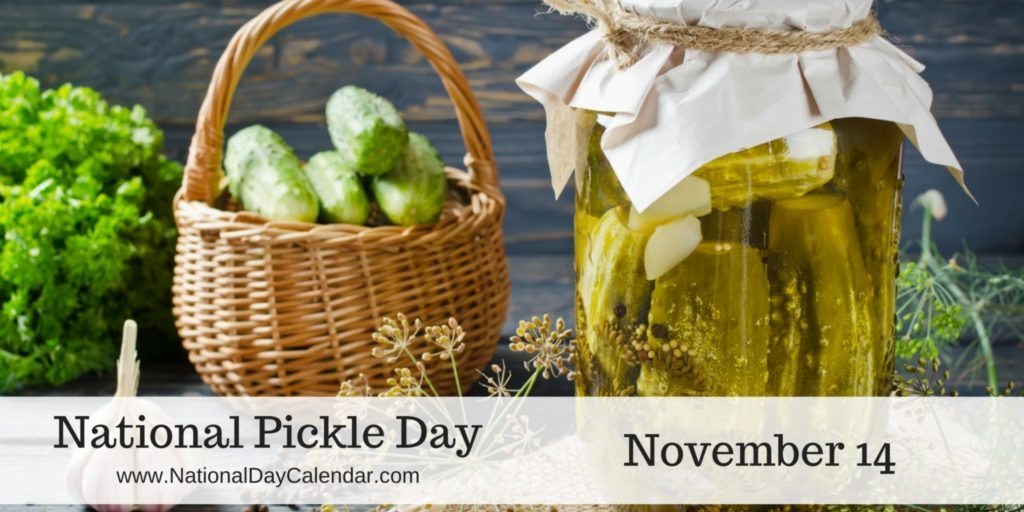
Pickles: Sweet or Dill

It’s National Pickle Day. Which are your favorite? Sweet or Dill?

I grew up in a big two-story house in the southern tier of New York state. You could walk a large circle downstairs from room to room. In the hall between the kitchen and bathroom there were “things” lined up against the wall; the dog’s water and food bowl, the Charlie Chip can, an extra kitchen table chair, and, a crock of icicle pickles. If I had friends over, it wasn’t unusual to stop at the crock and help ourselves to a snack. Those were the good old days.

My husband’s family has a recipe for dill midgets. They put small cucumbers in jars with a saltwater brine, stuff in some dill and garlic and leave the jars on the counter for ten days before eating. The first time I saw them made I insisted the jars wouldn’t seal unless they were put in a hot water bath, but I was wrong. My sisters make bread-and-butter pickles and they always put them in a hot water bath after filling the jars. I don’t understand why the dills don’t need it.

We buy almost all of our fresh vegetables at a public market. Every year when the cucumbers are in season we walk slowly past looking at them with longing and share our memories of home-made pickles. We rarely make them, and why I don’t think to eat them at home I can’t explain. My sisters still do.

In our city we have a couple of burger joints that still have a condiment bar with things like onions, relish, and pickles for the taking. If we go to the one that has sweet pickle slices we eat them as an appetizer. The dill slices we put right on the burger. Funny how people choose to join flavors to get an enhanced one. Oh, and we always add the onions.

I have a friend that is a health nut and she eats sour things on purpose to make her body more alkaline. Says it helps to stave off disease. She’ll eat a half a lemon if it’s on her plate, but refuses the dill pickle. We tease her and takes turns eating it.

In honor of the day…….Go eat a Pickle!

Scrapple? What’s That?

Scrapple is arguably the first pork food invented in America. For those who are not familiar with scrapple, which is also known by the Pennsylvania Dutch name “pon haus“, it is traditionally a mush of pork scraps and trimmings combined with cornmeal, wheat flour and spices.  (The spices may include, but are not limited to: sage, thyme, savory and black pepper.)  The mush is then formed into a semi-solid loaf, sliced and pan-fried

The immediate ancestor of scrapple was the Low German dish called panhas, which was adapted to make use of locally available ingredients and, in parts of Pennsylvania, it is still called Pannhaas, panhoss, ponhoss or pannhas.

I’m not personally acquainted with Scrapple so I included the above from the National Day of calendar.  When I mentioned it to my husband, he said, “I had it once in a restaurant near York, Pennsylvania,  and hope I never have to eat it again.” So much for the idea of making my own. I then looked up the contents of Spam; they are very similar except potato starch is used to hold things together instead of cornmeal. Maybe I will give one of the many recipes I found for scrapple a try and not call it that! It seems like it would be a good side dish for that weekend breakfast when no one wants to get dressed and there’s been too much bacon consumed recently. Seems anything covered with maple syrup as they suggest would be good!

Let me know how yours turns out!


We Eat That on Purpose

Do you like moldy cheese?  Not the kind that isn’t supposed to be discolored, but that beautiful blue color we look for on purpose to add to the Italian dressing on a tossed salad; you know, that costs anywhere from seventy-five cents to almost two dollars extra in a restaurant.  My husband and I do.  We also go to the public market to get a good deal on five-year old extra sharp cheddar cheese.  Yum.  My kids call it “stinky feet” cheese!

One advantage when you like moldy blue cheese comes when you are at a large party at a convention center or other large party place. It’s usually the cheese on the big cheese and cracker tray that is chosen least, so you can get your fill without a fight.  The only problem is it sometimes leaves a sour lingering aftertaste in your mouth.  The solution to that is another glass of good wine.  After all, it is a party.

I’m an old-fashioned wife, I still get up every work day morning with my husband and make his lunch while he showers.  It is always a salad; we buy those ingredients at the public market too.  The topping changes each day.  It could be tuna, beef, salami, left over Chinese, herring, salmon, chicken, whatever protein I can come up with.  The dressing is most often a homemade balsamic vinaigrette.  The cheese is alternated, Blue one day, and sharp cheddar the next.  He’s not a fussy man, and will eat most anything, that’s a blessing.  The only time I hear a complaint is when I forget the moldy cheese, or the onions!

Applesauce Anyone?

Have you ever driven past an apple orchard when it is in full bloom?  Not only is it pretty and serene, it smells fresh and flowery.  In the fall, when the apples are weighing the branches down, begging to be picked, you can once again enjoy the scent, but this time it makes your mouth water because you can almost taste the fresh warm applesauce or feel the juice running down your chin after a crunchy bite.

When I was young, we would get a peck of apples, wash them, cut them in quarters and put them, just like that, in a pot to cook.  Not much water was added, just enough so the apples didn’t burn.  Once they were cooked to the mushy stage, we would put ladles full in a cone shape colander then use a wooden thing that looked like a one handled rolling-pin with a blunt end (I don’t know its name) to force the sauce into another pot before we canned or froze it.  This process removed all the skins, seeds and stems.  The result was a pretty pink applesauce.  No preservatives, maybe a tiny bit of sugar. It sure tasted good when we ate it warm while looking out at snow drifts.

I have had the good fortune to live near Lake Ontario in New York state and in Washington state along the Columbia Gorge where apple orchards are plentiful.  It’s fun to drive past the orchards when the apples are ripe to see the green Granny Smiths, the reds of all types, and the Yellow Delicious. Stopping at a road side stand to buy apples is a must.

In Fort Wayne, Indiana in Johnny Appleseed Park there is a grave marking the spot where the legendary sower of apple seeds rests. He was born John Chapman on September 26, 1774, in Leominster, Massachusetts.  He  was a unique man whose appearance was as interesting as his mission.  He traveled, mostly barefoot, from Pennsylvania to Wisconsin, planting apple trees, taking care of sick orchards, and doing kind acts for people along the way.  When I was in grade school we learned about this man at this time of year. 
Next time you buy a bag of apples, or buy some fresh ones at a stand, remember Johnny Appleseed and his contribution to our lives, then enjoy a bowl of warm applesauce.

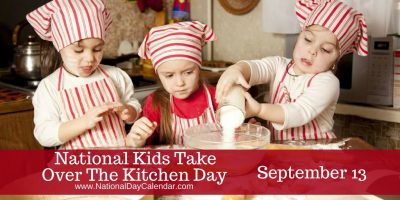
Let Your Children Serve You

I have a confession.  When I was a young mother, I didn’t have the patience to have my children help me in the kitchen.  I liked to get things done quickly, neatly, and with the expected outcome.  I didn’t know I was making a mistake by not letting them help, thus learn about cooking and responsibility.  The good part, they are both over 40 now and the main cooks in their households.  I’m proud of them for learning despite my actions.

Children like to feel like they are contributing.  I found with my grandson that if I asked for his help, instead of giving instructions and making demands, we had a good time.  At age one he was allowed to get all the pans out; he would  crash bang the lids, spread an obstacle course around the kitchen, then put them all in a circle with himself in the center.  It kept him occupied for a long time. He then graduated to wanting to help wash the dishes, then to cracking eggs for me while baking.  (One ended up on the floor and not in the bowl.  My daughter looked at me, shook her head and left the room.  I didn’t yell at him, just cleaned it up.  The rules change when you get older and it’s a grandchild.  I’m pretty sure she didn’t think it was fair.)

I remember some friends of ours who have three boys; they had to make the peanut butter and jelly sandwich different for each one.  How?  One wanted the jelly on the bottom, another had to have the jelly on top, and the third wanted his “fo-ded” (folded) not cut!  Mom was smart enough to make them all the same, and just place them on the plate the correct way.  One day Dad was on duty and he had to call Mom to find out the rules.  We are still laughing about it.

Let your kids take over the kitchen to celebrate this day.  If they are little, let them play with the bowls and spoons; if a little bigger, share the cooking but let them do the planning; the meal doesn’t have to fancy, a bologna sandwich will do; you get the idea; the only rule, they are not allowed to call for take-out.  Help them learn that serving (giving) is a wonderful trait that will take them farther in this world than any other.


It’s Never Too Late to Start

September 7th has five National Days attached to it so we’ll have a little fun, then learn that it’s never too late to start.

It’s Neither Snow, Nor Rain Day referring to having our mail delivered in all sorts of weather. Be appreciative!  After a long cold, rainy day your mail carrier might go to his/her local bar to warm up with some hot Acorn Squash (Day) soup, order a Salami (Day) sandwich, then cool the tongue with a Beer (Lover’s Day).  I know, silly, but you have to admit, it works!  Sort of!  And I know Facebook will probably only recognize the Beer part; maybe the mail carrier.

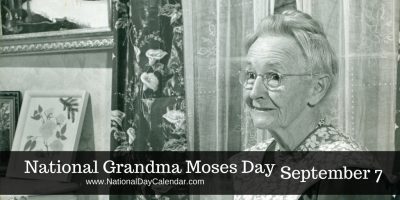
So let’s look at Grandma Moses;

Anna Mary Robertson Moses (September 7, 1860 – December 13, 1961) is an example to us all of an individual who successfully began a career in the arts at an advanced age. A renowned American folk artist, Grandma Moses first started painting in her 70s after arthritis made it difficult to embroider, her original medium.

Grandma Moses’ exhibitions were so popular during the 1950s that they broke attendance records all over the world.

“A cultural icon, the spry, productive nonagenarian was continually cited as an inspiration for housewives, widows, and retirees. Her images of America’s rural past were transferred to curtains, dresses, cookie jars, and dinnerware, and used to pitch cigarettes, cameras, lipstick and instant coffee.”

  • 1950 – Cited as one of the five most newsworthy women.
  • 1951 – Honored as Woman of the Year by the National Association of House Dress Manufacturers.
  • Age 88 – Mademoiselle Magazine named her “Young Woman of the Year.”
  • Awarded the first honorary doctorate from Philadelphia’s Moore College of Art.
  • 1969 – A United States commemorative stamp was issued in her honor.
  • 2006 – Her work Sugaring Off (1943) became her highest selling work at US $1.2 million.  Sugaring Off was a prime example of the simple rural scenes for which she was well-known.
  • Grandma Moses’ painting, Fourth of July, was given, by Otto Kallir, to the White House where it still hangs today.

g-m-4th

Did you catch that?  She started painting at age 70, and was “Young Woman of the Year” at age 88.  We should be so lucky!

I admire the bloggers I have contact with, some of them are under 30.  I didn’t have enough life experience to write at that age.  Like I said above, it’s never too late to start.


Website Built with WordPress.com.

Up ↑